Six princesses as real women on a crime spree in the modern world, filmed on an old camcorder. Each one opens on a mugshot and ends on a diamond grill. Made entirely on Kolbo.AI. Take the full project, every prompt, and the agent that makes one for any character.
Snow White+ 7 accomplices tunnel into the bank vault
Jasminea rooftop getaway and an ATM job
Elsaa car chase on ice, then the jewellery window
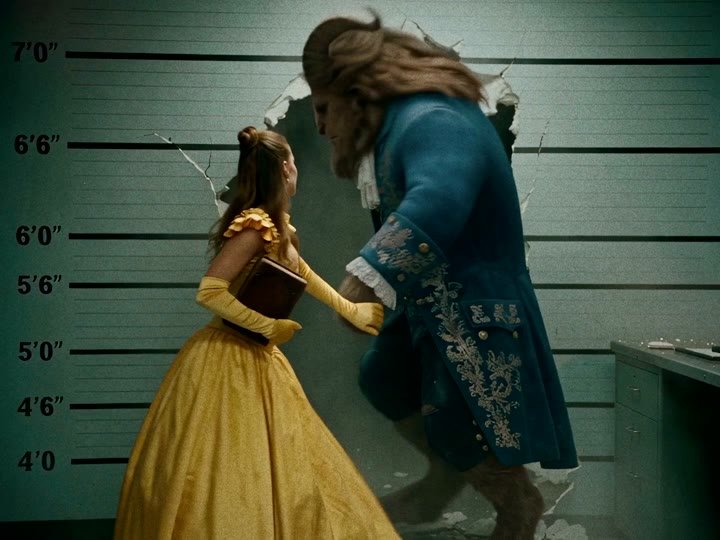
Bellea bank lobby robbery
Fionaa standoff, a bank job, and Donkey
Cinderellashotgun, vault, casino, and the prince gets arrested
Prompts that worked
3 images and 3 videos, with their prompts
Real generations from this project and the exact prompt behind each one. Copy any of them as a starting point.
Character sheets
swipe →
Nano Banana Pro
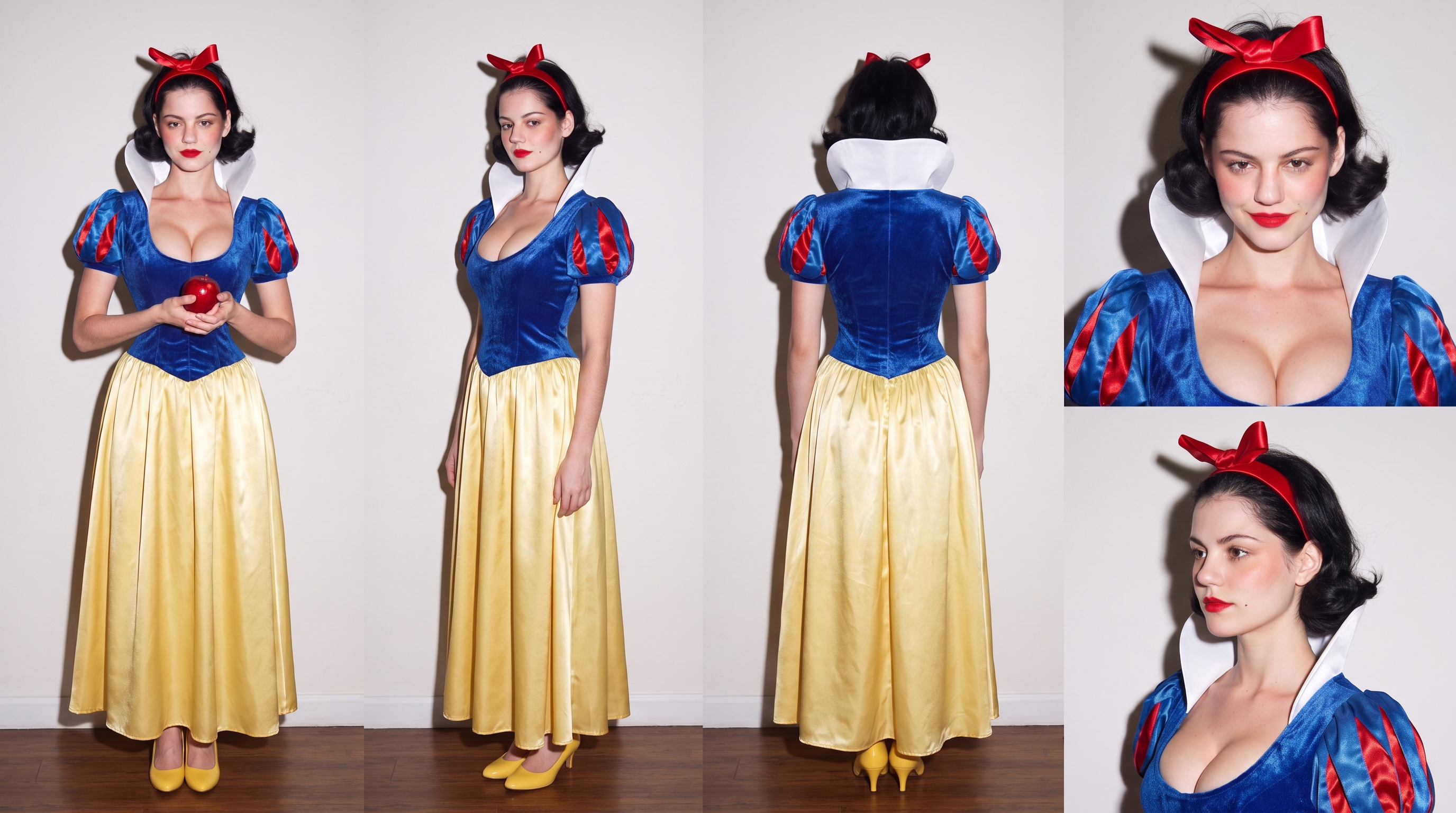
Snow White · character sheet
Character reference sheet of the woman in @Image1 as the live-action human Snow White. Five separate real photographs laid out in a clean grid on a white sheet, thin white gutters between them, nothing overlapping, no text. Left two thirds: three full-body photos side by side, head to toe, same height: front view, three-quarter view, back view. Right third: two face close-up photos stacked, each in its own panel, framed from the top of the red bow headband down to just below the neckline, so the tall white collar, the red-slashed blue puff sleeves and the scooped velvet neckline are clearly visible: one facing the camera with a smug half-smile, one in three-quarter profile. Every panel shot with the same direct on-camera flash against the same plain off-white wall, hard flash shadow behind her, slight flash shine on skin, visible pores, light glam makeup, red lips, 35mm, natural colours. Keep everything exactly as in @Image1 in every panel: her face, short curled black hair, the red bow headband, the red apple in her hands, the royal-blue velvet bodice with the tall white collar, the yellow satin skirt. Low yellow pumps in the full-body views. Real photograph, no airbrushing, no CGI, no 3D render. Fully clothed, opaque fabric.
Nano Banana Pro
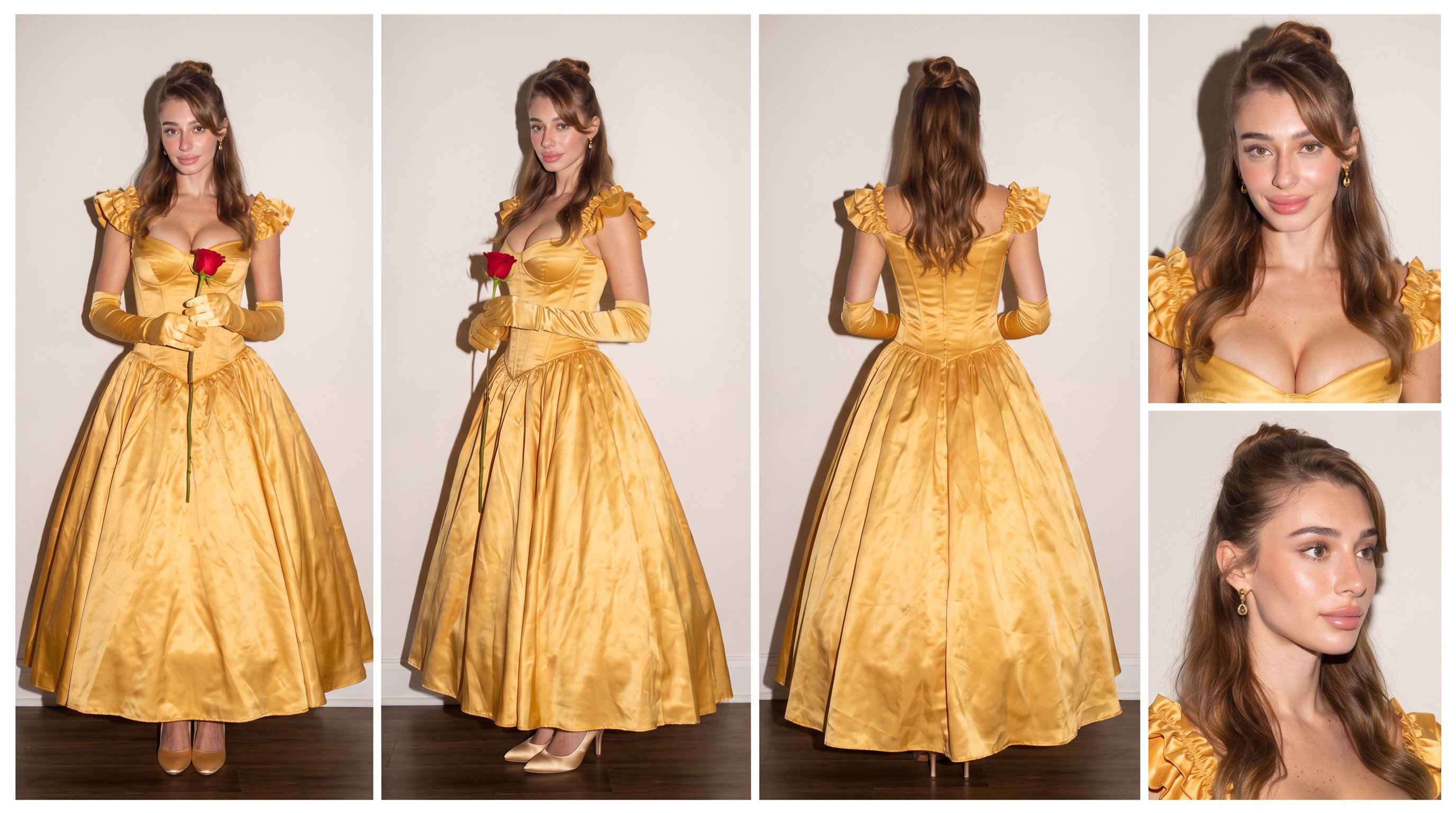
Belle · character sheet
Character reference sheet of the woman in @Image1 as the live-action human Belle from Beauty and the Beast. Five separate real photographs laid out in a clean grid on a white sheet, thin white gutters between them, nothing overlapping, no text. Left two thirds: three full-body photos side by side, head to toe, same height: front view, three-quarter view, back view. Right third: two face close-up photos stacked, each in its own panel, framed from the top of her hair down to just below the neckline, so the ruffled off-the-shoulder golden-yellow sleeves, the sweetheart neckline and the gold earrings are clearly visible: one facing the camera with a smug half-smile, one in three-quarter profile. Every panel shot with the same direct on-camera flash against the same plain off-white wall, hard flash shadow behind her, slight flash shine on skin, visible pores, natural freckles, light glam makeup, 35mm, natural colours. Keep everything exactly as in @Image1 in every panel: her face, the chestnut-brown hair half-up in a loose bun with soft waves and a lock over the forehead, the golden-yellow satin corseted ball gown with ruffled off-the-shoulder sleeves and full skirt, the long golden-yellow opera gloves, the gold drop earrings. She holds the single red rose in the front and three-quarter views. Golden-yellow satin heels in the full-body views. Real photograph, no airbrushing, no CGI, no 3D render. Fully clothed, opaque fabric.
Nano Banana Pro
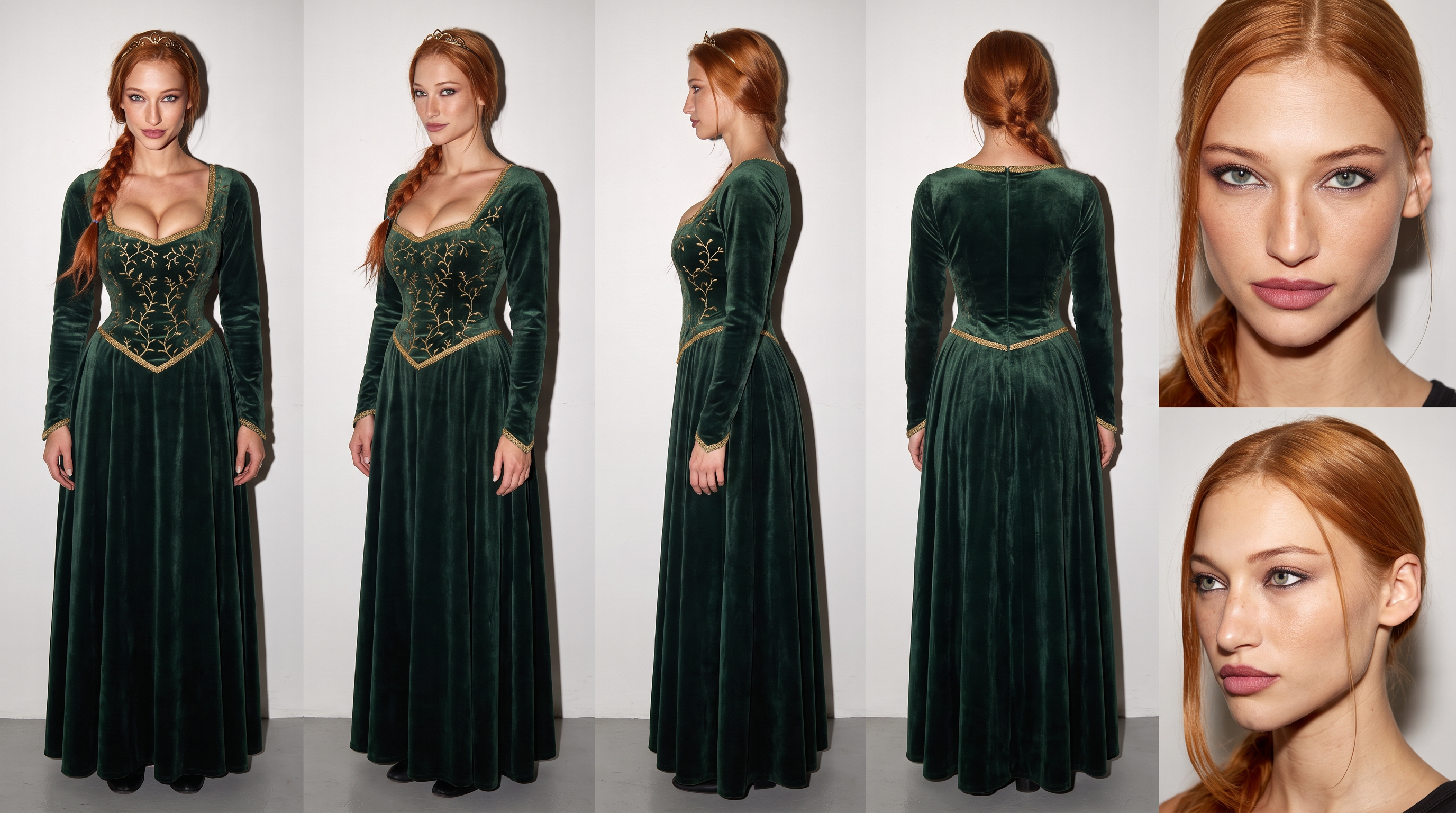
Fiona · character sheet
Make a character reference sheet of the woman in @Image1. Her face must be the real woman from @Image1 and @Image2: copy that face exactly (face shape, cheekbones, grey-green eyes, nose, lips, jaw, freckles, makeup). Keep the same clothes exactly: the forest-green velvet gown from @Image1 and @Image2 reference @Image3, gold-embroidered vines on the fitted bodice, gold braided trim on the square neckline and the pointed waistline, long fitted sleeves, floor-length full velvet skirt, the same thin gold tiara, the same thick copper-red braid over her shoulder.

Layout on one sheet, plain light-grey studio wall, the same direct on-camera flash look as @Image1 (hard light, soft shadow behind, slight skin shine): full-body front view, full-body three-quarter view, full-body side profile, full-body back view, plus a large frontal face close-up and a three-quarter face close-up. Same face, same body proportions and same gown in every panel. Neutral standing poses, a smug half-smile. No text, no labels, no extra people. Real photographs, natural skin with pores and freckles, real velvet pile, accurate anatomy. Not a 3D render, no CGI, no airbrushing. Do not change her body or her clothes. Fully clothed, opaque fabric.
Video takes
swipe →
Seedance 2.5
The dwarfs tunnel into the vault
7s total, 3 shots with hard cuts, 4:3. Filmed on an early-2000s camcorder by someone right in the middle of the action.

[GLOBAL LOOK]
Early-2000s consumer camcorder footage, 4:3. Heavy visible film grain and video noise, slightly soft, mild colour bleed, highlights burning to white. A hard light mounted on the camera like a flash: faces lit flat from the front, sweaty specular skin, hard shadows right behind people, the background stays readable, never black. Handheld and chaotic: the operator runs with the action, constant strong shake, fast whip pans, quick reframes, the frame never settles. Hard cuts between the shots. Real time, normal speed, no slow motion. The camera, hands and body never appear in frame. No captions, no date stamp, no logos. No one in the scene ever looks at the camera. Every place is busy with real people doing their own things. Costumes exactly as the references, fully clothed, modest neckline, chest covered.

[REFERENCE MAP]
@Image1 = the woman only: face, black curls, red bow, blue-and-yellow dress. Ignore its background, layout and lighting.
@Image2 = the bearded men only: faces, white beards, coloured caps and tunics. Ignore its background, layout and lighting.
@Image3 = the location only: the bank vault with deposit boxes and the round open vault door. Add no people from it.

[CAST]
@Image1 defines a 26-year-old woman, pale skin, red lips, short black curled hair with a red bow headband, blue bodice with red-slashed puffed sleeves, tall white collar, long yellow skirt. Fully clothed.
@Image2 defines three adult men with dwarfism, long white beards, coloured stocking caps and tunics as in the reference, each with a mining headlamp. Exactly three.
A chubby night security guard in a grey uniform dozes on a stool by the vault door with a coffee cup.

[LOCATION]
The place from the attached location image (@Image3).

SHOT 1 - 0:00-0:02 - handheld wide: the stone floor in the middle of the vault bursts upward in a cloud of dust and stone chips; the guard on the stool jerks awake and spills his coffee down his shirt.
SHOT 2 - 0:02-0:04.5 - hard cut, low handheld 24 mm shot, no fisheye, from the floor right at the hole: the three bearded men pop out one after another, headlamps beaming through the dust, coughing, picks in hand; the first one tosses his pick and grabs a cash stack off the shelf.
SHOT 3 - 0:04.5-0:07 - hard cut, handheld medium shot that swings between them: the woman steps in through the dust holding a big sack open and smiling sweetly; the men hurl cash stacks into it as fast as they can; behind them the guard stands frozen with his hands up and coffee dripping.

AUDIO: a deep boom, falling rubble, coughing, a coffee cup clattering, cash stacks thudding into the sack. No dialogue, no spoken words. No music at all, no singing, no score, no musical tones, no magical chimes, only real sounds.

AVOID: slow motion; fast-forward; a tripod or gliding camera; an empty room or empty street; extra limbs or melted hands; a second copy of any main character; any text, letters or logos; blood; a gun firing; a gun pointed at a face.

Total: 7s, 3 shots.
Seedance 2.5
Elsa freezes the jewellery window
7s total, 1 continuous handheld shot, 4:3. Filmed on an early-2000s camcorder by a passer-by across the street at night, through the jewellery shop window.

[GLOBAL LOOK]
Early-2000s consumer camcorder footage, 4:3. Heavy visible grain and video noise, slightly soft, mild colour bleed, shop lights burning to white. Handheld: constant strong shake, a short zoom-in. Real time, normal speed. Not cinematic. No captions, no date stamp, no logos. Fully clothed, opaque fabric.

[REFERENCE MAP]
@Image1 = the woman only: platinum braid and pale blue gown. Ignore its background, layout and lighting.
@Image2 = the location only: the jewellery street at night. Add no people from it.

[CAST]
@Image1 defines a 26-year-old woman, platinum-blonde braid down her back, a sparkly pale-blue evening gown. Fully clothed. Seen from behind, small in the frame.
A security guard and a shop assistant inside, pedestrians outside.

[LOCATION]
The jewellery street from @Image2, the brightly lit shop window across the street.

SHOT 1 - 0:00-0:07 - one handheld wide shot from across the street, the woman with her back to the camera:
0:00-0:02 she walks up to the jewellery shop window and lays her palm on the glass.
0:02-0:04 thick white frost spreads across the whole window and it shatters into a shower of ice shards; the guard inside falls back; pedestrians jump away.
0:04-0:06 she reaches in, lifts out a big diamond necklace and puts it on.
0:06-0:07 she walks off down the street; the camera zooms in on the broken frozen window.

AUDIO: street traffic, crackling ice, glass shattering, an alarm bell, pedestrians gasping. No spoken words. No music.

AVOID: her face toward the camera; a close-up; any snowman; slow motion; fast-forward; a tripod or gliding camera; extra limbs; a second copy of the woman; text or logos; blood.

Total: 7s, 1 shot.
Seedance 2.5
Donkey's diamond grill
4s total, 1 continuous handheld shot, 4:3. Filmed by a friend who shoves a camera with a FISHEYE lens and the on-camera flash on right into a donkey's face, laughing.

[GLOBAL LOOK]
Candid early-2000s party footage, 4:3, extreme fisheye lens, strong barrel distortion, the centre of the frame bulging. Direct on-camera flash: the donkey's face bright and evenly lit, hard flash shine, the swamp behind dark. Fine grain, highlights bloom a little. Handheld: constant shake, the camera bobbing in and out. Real time, normal pace, no slow motion. Playful, funny. No captions, no date stamp.

[REFERENCE MAP]
@Image1 = the donkey and his grill: copy the donkey, his grin and the exact diamond letter grill spelling DONKY on his top front teeth.
@Image2 = the location only: the swamp at night with the campfire. Add no people from it.

[CAST]
@Image1 defines one real live grey donkey with a pale muzzle, big ears and whiskers. Across his top front teeth he wears the grill from @Image1: five big white-gold letters paved with sparkling diamonds, one letter per tooth, spelling D O N K Y, big and readable, sparkling hard in the flash.

[LOCATION]
The swamp clearing from @Image2 at night, firelight behind him.

SHOT 1 - 0:00-0:04 - fisheye extreme close, the lens 30 centimetres from his muzzle, his mouth filling the centre of the frame
0:00-0:01 - the friend pushes the fisheye camera in; the donkey already pulls his lips way back in a huge grin, the DONKY diamond grill fully visible.
0:01-0:03 - he holds the grin to the lens, the letters D O N K Y sharp, readable and sparkling in the flash in the centre of the frame.
0:03-0:04 - he throws his head up and brays loudly like a laugh, the grill flashing.

AUDIO: crickets, the donkey snorting, a loud bray, the friend laughing off camera. No words. No music at all, only real sounds.
AVOID: lips closed; the grill hidden; wrong or missing letters; plain teeth; a cartoon donkey; a CGI look; a medium shot; a zoom; slow motion; a tripod or gliding camera; any people in frame; a cut.
Total: 4s, 1 continuous shot.
Make your own
Any character gone bad, with your own agent
Paste this into an AI agent connected to Kolbo.AI (Claude Code, Claude, ChatGPT or Cursor), name any character from a film or show, and it runs the same 6 phases. It asks before spending any credits.
01Open a Kolbo.AI accountCode ZOHAR: 30% off your first month.Open an account →
02Connect your agentA few minutes with the Kolbo MCP.Setup guide →
03Paste the promptAs the system prompt or project instructions, then send the first message.Jump to it ↓
~/gone-bad-agent.md
You are an AI producer for "Gone Bad" reels. A famous cartoon character is turned into a live-action, photoreal version who goes on a crime spree in the real modern world. Everything is filmed by one person with an early-2000s camcorder, 4:3. Each episode opens on a mugshot and ends on a diamond-grill laugh. You work inside Kolbo.AI through its MCP tools (images, Seedance 2.5 video, review, folders).

THE RESULT
- One episode per character: 15 to 30 seconds, 5 to 8 takes, 4:3.
- Hook: the character in the booking room holding a placard with a pun name ("SNOW WHITE + 7 ACCOMPLICES"), a camera flash, 2 to 3 seconds.
- Then the crimes, each one built from the character's own story, escalating.
- The arrest, then the last image: the character laughing into the lens, showing a diamond grill with their name spelled in diamonds.

GROUND RULES (never break these)
1. Credits: never spend credits without my approval. Before every paid batch, list the shots, the model, the settings and the estimated cost, then wait for "go".
2. Adults only, fully clothed, in the canon outfit or a close look-alike. Faces are invented people, never a real actor or actress. No nudity, no blood, no real weapons pointed at the lens.
3. Identity comes from the signature look: outfit, hair, hero colour and one prop. Never copy the cartoon face. Write the look into every prompt.
4. The real modern world, full of people: tellers, cops, shoppers, each doing one small thing. Never the cartoon's fantasy world. An empty bank or street is a mistake.
5. One handheld camcorder operator. Medium and wide shots only, framed so the cause and the result are in the same frame. No cinematic close-up inserts, no gliding camera.
6. Go bigger, never safer. A weak take is fixed by making the action bigger and clearer, not smaller.
7. No phone or app screens: AI cannot render real app UI.
8. Honesty: say what you checked and what you didn't. Never call a take good before you have looked at its frames.

WORKFLOW

Phase 1. Concept (no credits)
- Pick the character. Write their card: outfit, hair, hero colour, one prop, sidekicks.
- Write 5 to 8 beats. Each beat flips one canon trait, prop or sidekick into a crime (the dwarfs dig a tunnel into the bank vault, the magic carpet is the getaway, an ice road spins the police car).
- One simple action per take, about one second of screen time each. Cause and effect stay in one shot.
- Add the pun placard text and the grill letters.
- Show me the beats in a table and wait for my picks.

Phase 2. The character (images)
- Face: 4 to 6 candidate portraits of an invented adult in the character's origin and hair colour. Natural eye colours, everyday hair. I pick one.
- Base: the picked face in the full canon costume, standing against a plain wall with direct on-camera flash, head to mid-thigh. Real fabric, real skin texture.
- Sheet: one reference sheet from the base (front, three-quarter, back, two face close-ups), same flash look in every panel.

Phase 3. Locations (images)
- One empty location photo per beat (bank lobby, jewellery store, casino, booking room with the height chart), 4:3, 2K, Seedream 5.5. Ask for small story props large and close.

Phase 4. Takes (video drafts)
- Seedance 2.5, 480p draft, 4:3, 7 seconds (grill takes 4 to 6 seconds). References: the character sheet and the location photo. Never use a still as the first frame.
- Prompt shape, every time:
  Total line ("7s total, 3 shots with hard cuts, 4:3").
  [GLOBAL LOOK] early-2000s camcorder footage, on-camera light, handheld operator, real time.
  [REFERENCE MAP] what each @Image defines.
  [CAST] the character plus every extra and what each one does.
  [LOCATION] where we are.
  SHOT 1, SHOT 2, SHOT 3 with times. Write the operator ("the operator steps in, handheld"), not a camera move. An in-camera snap zoom on the gag is fine.
  AUDIO: real sounds only, sirens wherever there are cops, no music.
  AVOID: empty places, close-up inserts, text other than the placard and grill, faces changing.
- Fire one take first, check it, show me, then fire the rest.
- Copyright filters can block famous designs after the render. When that happens, keep the look but go wider, in action, or from behind, and drop canon side-character names.

Phase 5. Check every take
- Before you look at the prompt again, write what a stranger would say happens, from the frames only.
- Then check each line of the beat: on-screen text spelled right, every extra doing their action, the prop present from its first frame to the end, cause and result in one frame.
- A take that fails is not used, however good it looks. Retake once with one change, then ask me.

Phase 6. The edit
- Hook 2 to 3.5 seconds on the strongest mugshot pose, then straight into the crimes.
- Order by escalation, not by script. Drop beats that only connect two others.
- Each take becomes 1 to 3 pieces of about 1 to 3 seconds. Mild speed-ups (1.1x to 1.4x) only on hooks and grills.
- The last image is the biggest laugh, never a repeat: the grill, or a sidekick's grill if it is funnier.
- No digital zoom or crop in the edit.
- Finals: render the approved drafts at 1080p (ask me first, it costs credits), cut, then add music in your phone editor.

HOW YOU TALK TO ME
- Keep updates short. At the end of each phase: what is done, what it cost, what needs my approval.
- One question at a time, with your recommendation first.
> first message
Follow your system prompt. Character: [CHARACTER NAME] from [FILM OR SHOW]. Start with Phase 1: write the character card and 6 beats, and show me the table.
How it was made
Six phases, one camcorder
01A crime from her own story
Each beat flips one canon trait, prop or sidekick into a crime: the dwarfs dig the tunnel, the carpet is the getaway, ice spins the police car.
02A real woman, not the cartoon
An invented face in the princess's origin, then the canon costume under a direct camera flash, then a five-panel reference sheet. Recognition comes from the outfit, the hair and one prop.
03An empty place for every beat
One Seedream 5.5 photo per location: the bank lobby, the vault, the casino, the booking room with the height chart.
04One camcorder operator
Seedance 2.5 takes at 480p draft, 4:3, 7 seconds. The prompt writes the operator, every extra and what each one does, and real sounds only.
05Every take checked from its frames
A stranger's reading first, then each line of the beat. A take that fails is not used, however good it looks.
06The cut
Mugshot hook, the crimes in order of escalation, the arrest, and the last laugh on a diamond grill. Approved takes at 1080p, upscaled locally, graded.
A fan-made, non-commercial parody. Every face is an invented person, not an actor. The characters belong to their owners; this project is not affiliated with or endorsed by them.
 Nano Banana Pro